Home care runs on phone calls, faxes, and closed systems that don't talk to each other. Scheduling lives in one silo. Clinical data in another. Family communication in a third. Every integration is a custom project. Every vendor promises an open API that requires six months of engineering and a sales call to access.
We decided to do something different.
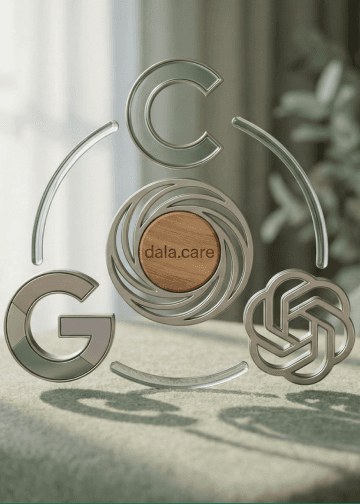
Today, dala.care becomes the first home care platform to ship native support for the Model Context Protocol, the open standard for connecting AI systems to real-world tools and data.
What MCP Actually Means for Home Care
MCP is not a product feature. It's a principle. It means that any AI assistant, any workflow tool, any developer can interact with dala.care's care coordination data through a standardized, open interface — without waiting for us to build a specific integration.
Concretely, this means:
Care teams get context, not clicks. An AI assistant connected to dala.care via MCP can pull a care recipient's visit history, upcoming schedule, caregiver notes, and update the care plan based on a transcription in a single conversation. No tab-switching. No copying and pasting between systems. A care coordinator can ask a question in natural language and get an answer grounded in actual operational data.
A recorded assessment can be transcribed and used to update a care plan while you focus on other things. This single use case has the potential to free up hours every week.
Developers build on us, not around us. Any team building tools for home care, whether it's marketing, CRM, a remote monitoring platform, or something we haven't imagined, can connect to dala.care through MCP without a partnership agreement or a proprietary SDK. The protocol is open. The data is structured. The barrier is gone.
Open Does Not Mean Exposed
Let's address the obvious question: how do you open up a home care platform to AI agents without compromising the privacy of vulnerable people?
Carefully. And slowly.
This is why we took our time. The MCP integration has been our most thoroughly security-tested release to date, not because the protocol demanded it, but because the population we serve does. Every interaction an AI agent has with dala.care passes through the same trust boundary.
Agencies generate their own API keys or authenticate through oAuth. Each home care agency controls its own access credentials from within the dala.care dashboard. No key is issued without an explicit decision by an authorized administrator. Keys can be scoped, rotated, and revoked at any time.
Granular permissions govern every capability. An API key or user based oAuth access doesn't unlock everything. Agencies define exactly which data types and operations each key can access. Read-only schedule views, care plan updates, caregiver availability, or any combination. An integration that needs to check visit times doesn't get access to clinical notes. The principle is least privilege, enforced at the key level.
Every AI action is audited. Every read, every write, every update made through MCP is logged with a full audit trail, who authorized the key, what was accessed, what was changed, and when. If an AI agent modifies a care plan or reassigns a visit, there is a clear, traceable record. Agencies can review AI-initiated changes the same way they review any staff action.
We believe openness and privacy are not in tension. They're in sequence. You build the controls first, test them thoroughly, and then you open the door.
Why Open Matters More Than Proprietary
The home care industry has been locked into proprietary systems for decades. The result is predictable: fragmented data, frustrated care teams, and families left guessing.
We believe the path forward is openness by default. Not because it's fashionable, but because care coordination is fundamentally a multi-party problem. The care recipient, their family, their caregivers, their clinicians, their pharmacy, their insurance, everyone needs access to the same ground truth. Proprietary walls don't protect anyone. They just slow everything down.
MCP gives us a way to be open without being chaotic. The protocol handles authentication, capability discovery, and structured data exchange. We control what's exposed and how. But the interface itself belongs to no one, which means it belongs to everyone who needs it.
One More Thing
Here's the part we're most excited about.
We know MCP is already drawing criticism, some calling it legacy technology within its first year of existence. The protocol is young, and the ecosystem is evolving fast. Developers building with Claude Code and similar agentic tools are already pushing past what server-based integrations can offer.
So alongside our MCP server, we're releasing the dala.care.skill — a Claude Code skill package that gives AI coding agents direct, structured access to dala.care's platform capabilities.
The skill file is designed for developers who work inside their terminal, not inside a dashboard. Drop dala.care.skill into your Claude Code environment and your agent understands how to interact with care schedules, recipient records, caregiver availability, visit logs, and clinical eligibility data — natively, without standing up a server or managing a connection.
Think of it this way: MCP is the open door. The skill is the fluent guide who already knows the building.
We're shipping both because we don't think it's our job to predict which integration pattern wins. It's our job to make sure that whoever is building the future of home care technology can build it on top of real data, right now, with whatever tools they prefer.
What's Next
Sign up for dala.care for free today.
The MCP server and dala.care.skill are available today.
We'll be expanding the exposed capabilities over the coming weeks and look forward to your feedback.
If you're building something for home care and want to connect, we'd like to hear from you. Not through a sales process. Through the protocol.